
Flow State in Youth Soccer: The Role of Coaching Methodology and Competitive Context
Learn how the flow state impacts youth soccer development and how coaching methodology and competitive balance create optimal learning environments.
4/4/20264 min read
The concept of flow, originally developed by Mihaly Csikszentmihalyi, has become a central construct in sport psychology to explain optimal performance states. In youth soccer, understanding how flow emerges is not only relevant for performance, but also for long-term player development.
From an applied perspective, the responsibility for facilitating flow does not lie solely with the athlete. Rather, it is largely shaped by the methodological competence of the coach and the competitive environment designed by the club (Susan A. Jackson & Csikszentmihalyi, 1999).
Flow as an Emergent Property of the Training Environment
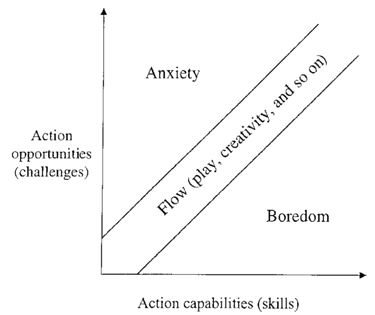
Flow is defined as a psychological state characterized by total task immersion, clear goal orientation, and intrinsic motivation (Csikszentmihalyi, 1990). Its emergence depends on a critical condition: the balance between perceived challenge and individual skill level.
Contemporary research in soccer pedagogy highlights that training environments emphasizing decision-making, tactical awareness, and contextualized learning significantly enhance player engagement and cognitive performance (Wenjie et al., 2025).
These conditions are not accidental, they depend on how training sessions are structured.
The Coach as an Architect of Flow
The coach plays a central role as a designer of learning environments. Research in coaching science (Sanmiguel-Rodríguez et al., 2023) highlights that methodology directly impacts player engagement and performance. Effective coaches manipulate key variables such as:
Space and time
Number of players
Task constraints and objectives
Effective coaches create conditions aligned with three key principles:
Representative Learning Design
Training tasks must replicate the perceptual and decision-making demands of the game.
Optimal Challenge Calibration
Activities should be adapted to the player’s current ability, ensuring continuous but manageable difficulty.
Guided Autonomy and Feedback
Players must be allowed to explore solutions while receiving timely and specific feedback.
This aligns with the Spanish Development Model (SDM™), which emphasize age-appropriate, engaging, and inclusive environments as foundational to player growth. Additionally, studies on representative learning design (Wenjie et al., 2025) show that game-realistic training environments significantly improve decision-making and tactical behavior.
When training reflects the realities of the game, players are more likely to:
Stay cognitively engaged
Process information more efficiently
Experience the conditions associated with flow
This aligns with broader developmental frameworks in sport, where learning is understood as an active and contextual process (Côté, Baker, & Abernethy, 2007).
Competitive Context: A Structural Constraint in the United States
While training design is critical, competition structure is equally determinant.
For flow to emerge consistently, players must be exposed to appropriate competitive demands. This requires clubs to compete in leagues and divisions that reflect their players’ true level.
When this alignment fails, two common scenarios illustrate the problem:
One-sided victories (e.g., winning 8-0):
Reduced cognitive engagement, minimal decision-making pressure, and limited development.
Chronic underperformance (non-competitive losses):
High anxiety, low confidence, and disengagement.
Neither scenario satisfies the challenge, skill balance required for flow. Consequently, both are detrimental to long-term development, regardless of short-term results.
Progressive academies increasingly recognize that developmentally appropriate competition is not optional, it is a structural necessity. Environments that prioritize growth over results foster players who can adapt, think, and perform under realistic constraints (Côté et al., 2007).
Integrating Methodology and Philosophy
Player development is most effective when training demands and competitive demands are aligned. When this alignment exists:
Training prepares players for realistic scenarios
Games reinforce learning under pressure
Players remain engaged and motivated
Training environments that prioritize decision-making, awareness, and purposeful practice enable players to engage deeply with the game and sustain attention under pressure (Swann et al., 2012).
This type of methodology reflects a broader shift in youth soccer: from repetition-based training toward context-driven learning, where players are active problem-solvers rather than passive executors.
Under these conditions, flow is more likely to occur — not as a rare event, but as a recurring part of the developmental process.
Conclusion
Flow should not be understood as a spontaneous or purely individual phenomenon. In youth soccer, it is the product of intentional design, emerging from the interaction between:
The coach’s methodological expertise
The structure of training tasks
The appropriateness of competitive environments
Clubs and coaches who fail to align these variables risk creating contexts where development is either stagnant or compromised.
Conversely, when training and competition are properly calibrated, players are more likely to enter flow states — where learning accelerates, performance stabilizes, and engagement with the game deepens.
In this sense, facilitating flow is not merely about enhancing performance. It is about creating the conditions in which meaningful development becomes possible.
References
Csikszentmihalyi, M. (1990). Flow: The psychology of optimal experience. Harper & Row.
Csikszentmihalyi, M. (1997). Finding flow: The psychology of engagement with everyday life. Basic Books.
Jackson, S. A., & Csikszentmihalyi, M. (1999). Flow in sports. Human Kinetics.
Swann, C., Keegan, R., Piggott, D., & Crust, L. (2012). A systematic review of the experience, occurrence, and controllability of flow states in elite sport. Psychology of Sport and Exercise, 13(6), 807–819.
Côté, J., Baker, J., & Abernethy, B. (2007). Practice and play in the development of sport expertise. In G. Tenenbaum & R. C. Eklund (Eds.), Handbook of sport psychology (3rd ed., pp. 184–202). Wiley.
Wenjie, C., et al. (2025). Tactical optimization and decision-making in football training. Humanities and Social Sciences Communications.
Sanmiguel-Rodríguez, A., et al. (2023). Coaching methodology and performance in football.
When this balance is disrupted, two maladaptive states arise:
Low challenge leads to boredom
Excessive challenge leads to anxiety
Thus, flow is not accidental. It is systematically produced (or inhibited) by how training and competition are structured (Csikszentmihalyi, 1990; Swann et al., 2012). Further applied research by Susan A. Jackson and Csikszentmihalyi (1999) shows that athletes are more likely to experience flow when:
Objectives are clear
Feedback is immediate
The athlete feels a sense of control
Contact
Get in touch with MOCH for soccer support
info@mochsoccer.com
European Soccer Performance & Methodology Consulting Firm
Menu
Support
© 2025. All rights reserved.


MUCH more than Soccer